The Surprising, Costly Trap Hiding In Your Cheapest Offer
There’s a pattern I’ve noticed after years of reading through our support inbox that most business owners never think to look for. The most demanding message rarely comes from the customer who spent the most. It comes from the one who paid the least.
I used to find that odd. You’d think someone handing over £500 would expect the most from you, and someone paying £7 would barely notice if something went wrong. In my experience, it’s almost always the other way round. The cheaper the offer, the more time it tends to take up: in refund requests, in questions, in customers who were shopping on price rather than looking for a solution.
If you want to attract better customers, it turns out the answer sometimes has less to do with your marketing and more to do with your price tag. That’s not an easy thing to say to anyone trying to build an audience from nothing. But it’s worth sitting with, because it changes how you think about your first few offers.
The Cheap Customer Problem Nobody Warns You About
In any business that sells online, there’s an assumption that lower prices bring in more people, and more people must be good for business. On the surface, that’s true. Cheap products sell in volume.
But the volume isn’t free.
It comes with its own cost, and it rarely shows up on a spreadsheet. It shows up in your inbox.
The £7 product doesn’t just attract someone with £7 to spend. It attracts someone who is choosing almost entirely on price, and someone shopping on price is comparing you against everyone else doing the same thing, right up until the moment they click buy, and often afterwards too.
Price Doesn’t Just Set Your Income. It Sets Who Shows Up
Someone paying £5 or £10 has usually not yet decided the problem is worth solving. They’re testing the water. Someone paying £300 or £500 has already decided. They aren’t trying to save a few pounds. They’re trying to save themselves weeks of frustration, and that’s a completely different person to deal with once the sale is made.
I think this is one of the most underrated ideas in this whole industry, more so than any traffic trick or algorithm update. Who you attract matters more than how many you attract.
Price is a filter, not just a figure.
Get that filter wrong, and you’ll spend your time firefighting instead of building.
A Refund Taught Me More Than Any Pricing Course Could
Early on, every refund request felt personal to me. I knew how much work sat behind the products we’d built, and having someone ask for their money back felt like they were telling me the work wasn’t good enough.
It took a while to see it differently. A refund isn’t a verdict on the product. Sometimes it’s simply a mismatch between what someone expected and what they were actually prepared to do with it.
These days, I’ll always try to help first, because sometimes a person just needs pointing in the right direction. But if someone genuinely wants to go, I let them go gracefully, update the database, and don’t chase them.
The customers who ask for refunds most often, in my experience, are rarely the ones who paid the most.
What Attracting Better Customers Actually Looks Like
This isn’t an argument for making everything expensive, or for looking down on anyone who can only afford a smaller offer. It’s an argument for being honest about what a very low price attracts, so it stops being a surprise every time it happens.
A higher price tends to attract someone who has already decided the problem is worth solving, who reads the whole page before buying, and who implements rather than argues. Those are the people who become repeat customers, refer their friends, and rarely write in demanding a refund after sending a single email and calling it no support.
You’ll recognise them quickly once you’ve dealt with enough of the other kind.
We write about this sort of thing fairly often, and if it’s useful, there’s more on pricing and customer behaviour in other articles I’ve shared recently.
Low Ticket Products Still Have a Place
None of this means a £9 checklist or a £19 template is a mistake. It just means you shouldn’t expect it to carry your business, or to bring in the customers who need the least hand-holding.
Think of a cheap product as a handshake, not a house. Its job is to introduce someone to how you work and build enough genuine trust that saying yes to your next, more substantial offer feels obvious rather than risky.
The Next Step If You Want to Build Something With More Value
If any of this has you thinking about building something with more substance than a single low priced download, Nick James has put together a free book called Six Figures A Year In Information Publishing, walking through what it actually takes to build a proper information business rather than a stack of one-off downloads sold on price alone.
It’s a sensible next step if you’d rather compete on value than on who can go cheapest, and you can find it here: Six Figures A Year In Information Publishing.
Have a look through it when you’ve got a spare half hour. There’s no charge to read it, and no harm in seeing whether the thinking behind it matches what you’re already noticing in your own inbox.
Best wishes for now,
Kate
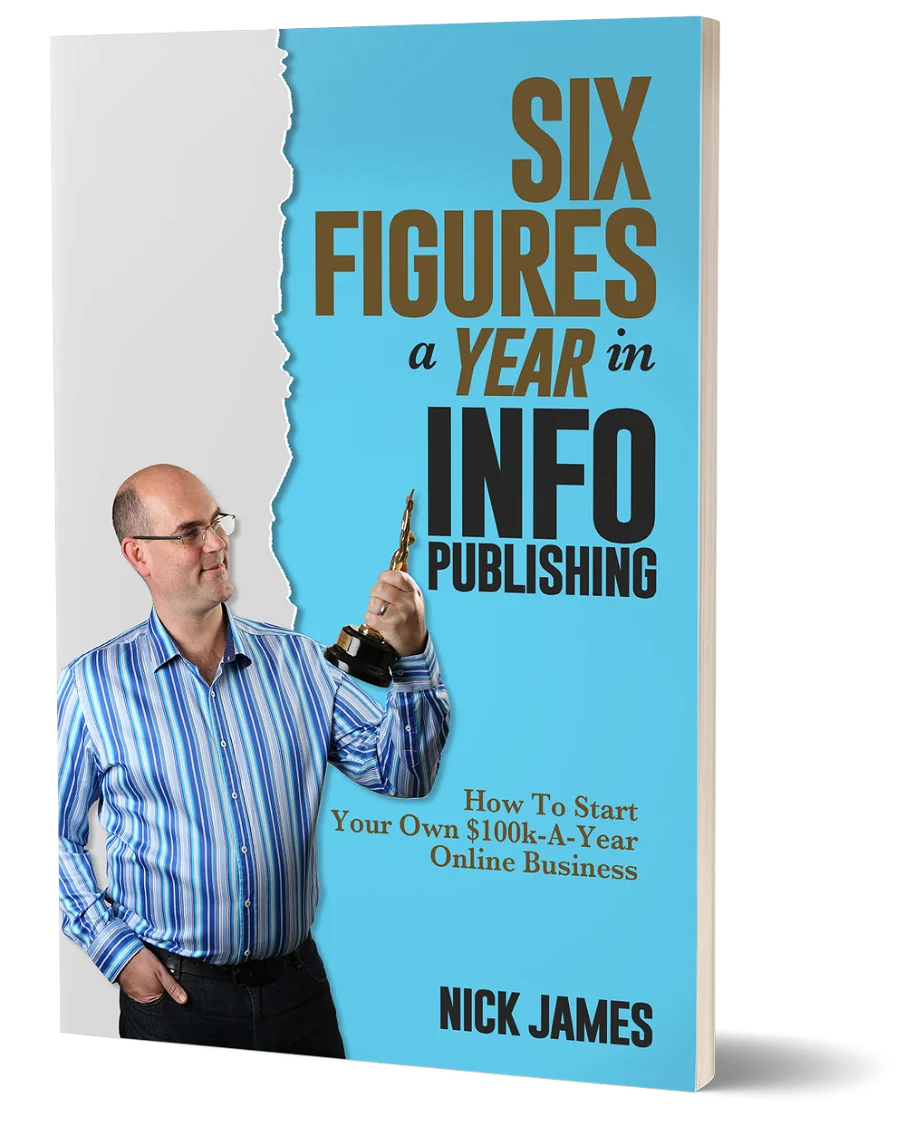
Author offers a FREE copy of this book to his next door neighbor... to prove he's not a drug dealer!
Now claim your FREE COPY.
and follow the step-by-step instructions for making the kind of money (and living the kind of lifestyle) that'll get your neighbors curtains twitching with curiosity!
Enter your details below to discover how to claim your FREE COPY of 'Six Figures A Year In Info Publishing' ...
Privacy Policy : We value your privacy. You can unsubscribe from receiving future emails with 1 click at any time.