5 Overlooked Mistakes That Make Licensed Products Costly
There’s a belief that gets passed around this industry like it’s gospel: if a licensed product is cheap enough, it’s automatically a bargain. Buy it, slap your name on it, sell it, done.
I think that belief is wrong. I think it’s the exact belief that’s cost a good number of people buying licensed products their confidence, their money, and sometimes their willingness to try again.
Here’s the part nobody says out loud. A cheap licensed product that needs ten hours of rewriting before you can put your name anywhere near it isn’t cheap at all. It’s just expensive in a currency you didn’t think to count. Multiply that by every licensed product someone buys in a year, and the real cost stops looking small at all.
I’ve read enough support tickets over the years to know exactly where this goes wrong, and it’s rarely the product itself. It’s what happens after someone buys it.
The Real Cost Isn’t The Price Tag
Most people judge licensed products the way they’d judge anything else in a shop window. They look at the price, they look at the topic, and if both feel roughly right, they buy.
That’s not enough. Not for this.
The actual cost of a licensed product isn’t what you pay for it. It’s the time you spend afterwards, fixing what you assumed would already be finished.
A cheap licensed product that needs ten hours of rewriting before you can put your name anywhere near it isn’t cheap at all.
I’ve seen people pay twenty dollars for something and lose an entire weekend to it, then wonder why the ‘shortcut’ didn’t feel like one. Twenty dollars saved against ten hours spent is not a good trade, whatever the invoice says.
Think about what that ten hours actually looks like in practice. It’s checking every claim in the sales copy still applies. It’s noticing the screenshots are three software versions out of date and need remaking from scratch. It’s reading the whole thing once, then reading it again because the first pass missed the sentence that contradicts what you told your own list last month. None of that shows up on the page where you clicked buy.
‘Nobody Helped Me’ Is Rarely The Whole Story
I do subscriber and customer support for a living, and I’ve heard versions of ‘I didn’t get any support’ often enough to recognise the pattern underneath it.
Usually, what actually happened is this: someone bought a licensed product, sent one email asking what to do with it, didn’t get an instant reply, and quietly decided the whole thing was the vendor’s fault.
I understand the frustration. I really do. But a licensed product was never meant to arrive finished, wrapped, ready to make you money without a single further decision on your part. It’s a head start, not a hand-out.
‘I just don’t have the time’ is the other phrase I hear constantly, and I’d gently push back on it too. Most people have the time. What they don’t have is the fifteen minutes it takes to check something properly before they buy it, which then costs them a great deal more time later. Fifteen minutes spent reading the licence terms properly, checking who else holds it, and skimming the content for anything that contradicts what you already teach, is rarely the part anyone skips on purpose. It’s just the part that feels optional right up until it wasn’t.
What I’d Actually Check Before Buying Anything
I’m not going to pretend there’s one clever trick that fixes this. There isn’t. But there are a few plain questions worth asking before money changes hands.
How many other people already hold this same licence? If the number runs into the thousands, you’re not buying a head start. You’re buying a seat in a very crowded room, and your reader will notice the noise even if you don’t.
A quick example makes this concrete. If a licence has already been sold to two thousand other people, and half of them are active in the same Facebook groups as your reader, your reader will spot the recycled wording within a week. That doesn’t mean the product is worthless. It means the licence alone isn’t the asset. What you do with it is.
Does the licence allow you to actually change anything? Some don’t. If you can’t edit a word of it, and the content already reads a little tired, you’ve bought something you can’t fix.
And does it agree with what you already teach your own audience? I’ve seen people license something on a topic they already cover, only to find it contradicts their own advice by page two. Your reader holds both pieces of your content at once. That’s not a small problem.
I’ve written about some of the groundwork behind this in other articles I have shared recently, and it’s worth reading alongside this one before your next purchase.
Rebranding Isn’t Optional, Whatever You’ve Been Told
I think one of the more damaging pieces of advice floating around this market is that PLR and licensed products can go up exactly as they are. No rebranding, no rewriting, no thought given to your own audience at all.
It rarely works, and when it doesn’t, the vendor gets blamed for it. I’ve watched that happen more times than I can count.
A licensed product is a starting point. It’s proof that somebody, somewhere, has already done the hard part of building and testing something that sells. Your job is smaller than starting from nothing, but it isn’t nothing. Change the examples. Fix anything that dates it. Make sure it sounds like something you’d actually say.
That might mean swapping a case study that no longer fits, updating a screenshot, or simply rewriting the introduction so it sounds like you rather than whoever wrote it first. None of this takes ten hours if you do it before you promise anything to your own list. It takes ten hours if you do it after, with customers already waiting and your name already attached.
Do that, and a licensed product does save you months. Skip it, and you’ve bought yourself a different kind of problem, one with your name already on it.
If You Want The Checking Done For You
If working through all of this on every single licence sounds like more than you want to take on alone, my husband, Nick, put together a course called Product Licensing Formula. It walks through exactly how to find, check and prepare a licensed product properly before you ever put your name on it.
It won’t do the thinking for you entirely, and it shouldn’t. But it gives you a proper process to run every licence past, rather than relying on a gut feeling and a fair price.
The Question Worth Asking Before You Click Buy
Every licensed product you’re offered will look like a shortcut at first glance. Some of them are. Plenty aren’t.
The difference usually isn’t visible on the page selling it. It shows up three weeks later, in how much of your own time you’ve had to spend making it usable.
Ask the awkward questions before you pay, not after. It takes ten minutes, and it’s ten minutes that decides whether you’ve bought a head start or a weekend of work you didn’t sign up for.
Best wishes for now,
Kate
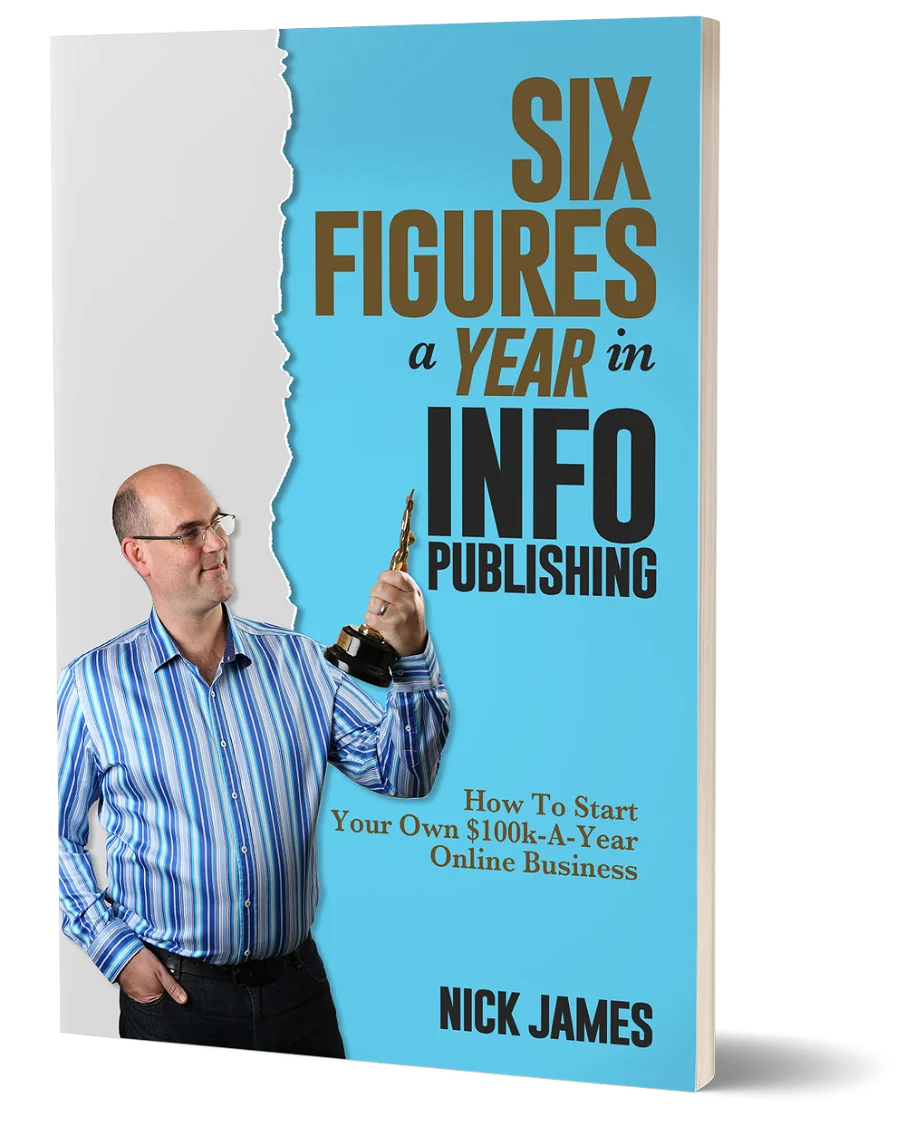
Author offers a FREE copy of this book to his next door neighbor... to prove he's not a drug dealer!
Now claim your FREE COPY.
and follow the step-by-step instructions for making the kind of money (and living the kind of lifestyle) that'll get your neighbors curtains twitching with curiosity!
Enter your details below to discover how to claim your FREE COPY of 'Six Figures A Year In Info Publishing' ...
Privacy Policy : We value your privacy. You can unsubscribe from receiving future emails with 1 click at any time.