How to Turn One Proven Skill Into a Little-Known Business Idea
Nobody helped me. I hear some version of that most weeks, from people who bought a course, worked halfway through it, and still could not tell you afterwards what they are now able to do.
It is rarely laziness, and it is rarely even a bad course. It is a gap nobody warns anyone about beforehand: finishing something and proving something are two entirely different outcomes.
There is a small, quiet kind of online business built entirely around that gap. Not a full course, not a membership, just a niche credential business: a clear standard, a short test, and a badge someone can properly use afterwards.
If you are looking for a way out of the nine to five, or something small enough to build alongside a job you are still holding down, this is worth thirty minutes of your attention today.
The Gap Between Finishing And Proving
Most online courses teach you how to do something. Almost none of them prove, afterwards, that you can.
That gap matters more than course creators tend to admit. An employer, a client or an agency owner does not want to know you watched forty videos.
They want to know you will not embarrass them in front of their own customer.
A finished course proves you sat through it. A credential proves you can do it.
That is the whole idea behind a niche credential business, and it works whether you are certifying photographers, virtual assistants, copywriters or community moderators.
None of this requires a fancy platform or a big following. It requires one skill, described narrowly enough that somebody hiring for it recognises themselves immediately.
Why Small And Specific Beats Big And Vague
The instinct, starting out, is to make the credential broad. Certified Marketer. Certified Assistant. Certified Copywriter.
Resist it. A broad credential competes with universities and enormous training platforms that have far more money and far more time than you do.
A narrow one does not compete with anyone.
Instead of Certified Virtual Assistant, think Certified Real Estate Transaction Assistant. Instead of Certified Photographer, think Certified Short Term Rental Photographer.
The narrower version sounds smaller. It is easier to sell, because the person hiring is not weighing you against everyone else carrying the same generic title. They are asking one question: does this person already understand my particular problem.
I have written a little more on choosing a workable angle like this, in other articles I have shared recently, and the same principle turns up again and again: specific beats impressive, every time.
Build The Proof Before You Build The Lessons
Most course creators build the lessons first and bolt a quiz onto the end. Reverse that order and the whole thing gets easier.
Decide first what someone has to demonstrate to earn the credential. Not answer correctly. Demonstrate.
A copywriter might have to repair a flawed piece of copy. A community moderator might be shown five difficult posts and asked what they would do with each one. A photographer might submit a finished set of images shot under ordinary, unglamorous conditions.
Picture a virtual assistant test built around real estate transactions. Instead of a multiple choice quiz about contract terms, the candidate might be handed a genuine, anonymised closing timeline with three deliberate errors buried in it, and asked to flag each one and explain what would go wrong if it went uncorrected. Somebody who has only watched a training video will guess. Somebody who has actually done the work will spot the pattern in seconds, because they have seen versions of that exact mistake before. That is the difference a real test protects: it separates people who have absorbed information from people who can act on it under ordinary pressure.
Ask one blunt question about whatever test you design: could somebody fake this without the skill. If the honest answer is yes, the test is not finished yet.
Only once that standard exists should you build the short training that gets someone able to meet it. You may need far less material than you expect. People are not paying for hours of video. They are paying to move from thinking they can do something to being able to prove it.
Borrow Credibility You Do Not Have Yet
A brand new credential has one obvious problem. Nobody has heard of it.
The fix is not a bigger marketing budget. It is a handful of respected names willing to look over your standard before you launch it.
Ask three or four people who already work in the field, or who hire people who do, to review what you are asking candidates to demonstrate. Most say yes far more often than people expect, because you are asking for ten minutes of feedback, not a favour.
This works even in a niche most people would assume is too small to have anyone worth asking. If you are certifying, say, short term rental photographers, there is likely a local property management company, a handful of active hosts in a Facebook group, or a photographer already established in a neighbouring city who would happily glance over your standard. You are not asking them to endorse you personally. You are asking whether the bar you have set matches what they would actually expect from someone they hired. That distinction makes the ask smaller and the answer easier to give.
Once they have helped shape it properly, and agree to be named, your credential stops being something you invented alone at your kitchen table. It becomes something built with people who already carry weight in that field.
That single change makes the whole thing considerably easier to sell, long before you have a track record of your own.
What This Could Look Like For You
You do not need a big following or years of authority to start this. You need one narrow skill, a handful of people willing to hire someone who has it, and the patience to build the standard properly before you sell anything against it.
Start smaller than feels comfortable. Pick one skill. Write down what competence looks like. Ask a few people who would hire for it whether your standard matches what they actually expect from someone they bring on.
Then build just enough training to help someone meet it, and a short, honest way to test whether they have.
Consider what happens six months in, once ten or twelve people hold the credential. Each of them becomes a small, quiet advertisement for the standard itself, because clients start asking for it by name once a couple of people mention it to each other. That is a slower kind of growth than a launch week, but it tends to be sturdier, because it is built on people actually being good at the thing rather than on a clever headline.
The people who have already tried the make money online route know the vague version does not work. A niche credential business is the opposite of vague. It says exactly what someone can do, and lets them prove it, rather than asking a stranger to take their word for it.
Where This Naturally Leads
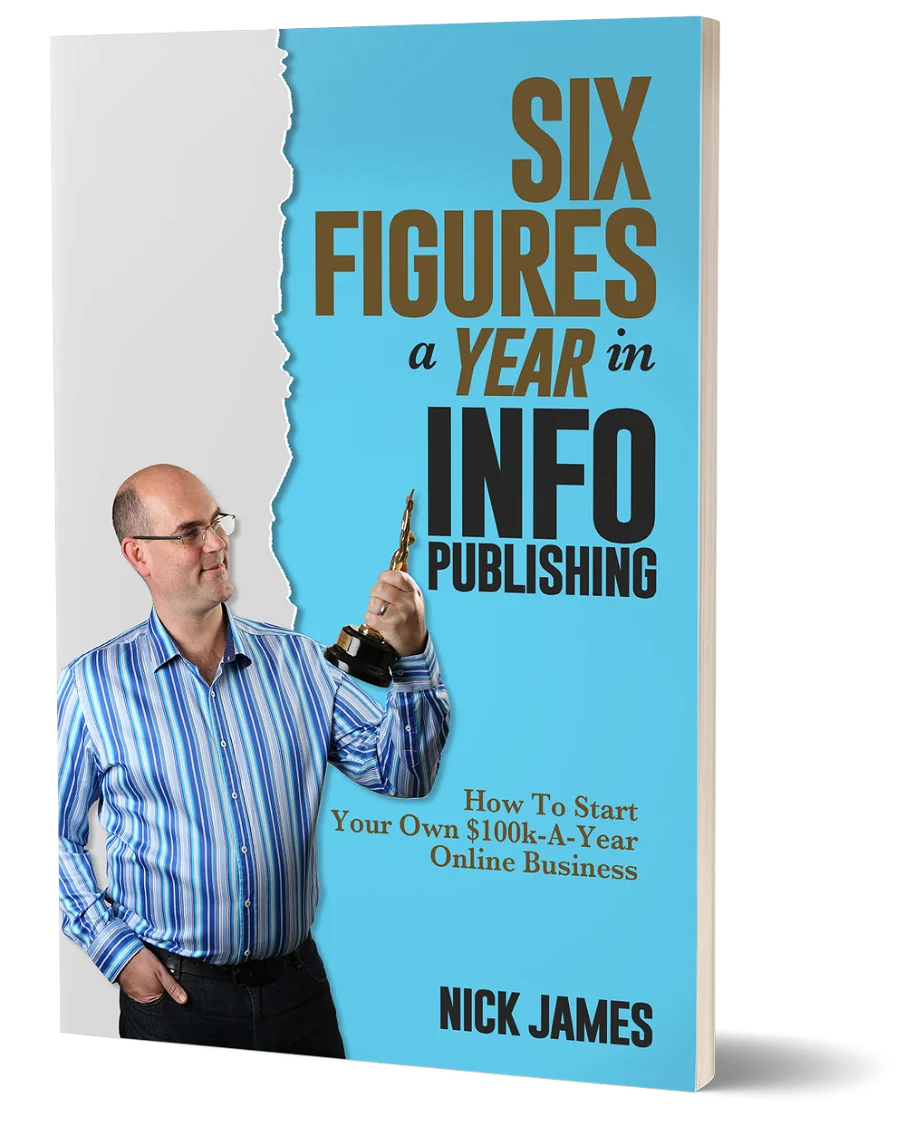
A niche credential business is really just one specific way of packaging what you know into something people can buy and trust. If you want to go further with turning knowledge into a proper product, rather than a folder of PLR you never got round to using, Six Figures A Year In Information Publishing is worth a look.
It is written by Nick James, and it walks through building an information product properly, from the idea through to something you can sell, rather than putting something out as-is and hoping for the best.
Nobody is promising you a figure or a timeline here. But if the credential idea has you thinking about structuring what you already know, this is a sensible next place to look.
None of this needs to happen this month. It needs to start with one honest decision: pick the one skill you would stake your name on, and build the proof around that, properly, before you build anything else.
Best wishes as always, Kate.
Author offers a FREE copy of this book to his next door neighbor... to prove he's not a drug dealer!
Now claim your FREE COPY.
and follow the step-by-step instructions for making the kind of money (and living the kind of lifestyle) that'll get your neighbors curtains twitching with curiosity!
Enter your details below to discover how to claim your FREE COPY of 'Six Figures A Year In Info Publishing' ...
Privacy Policy : We value your privacy. You can unsubscribe from receiving future emails with 1 click at any time.